

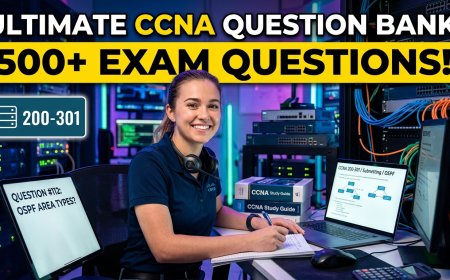
Ultimate CCNA Question Bank : 500+ Exams questions ! Part 03
This set tests fundamental concepts that frequently appear on the official Cisco CCNA exam.

Question 1 / 10
Which of the following best describes the purpose of the Native VLAN on an 802.1Q trunk link?
It encrypts all management and control traffic passing between switches.
It carries untagged traffic across the trunk link.
It designates which VLAN is allowed to bypass Spanning Tree Protocol (STP) blocking.
It automatically assigns IP addresses to neighboring switches using DHCP.
Question 2 / 10
An administrator needs to subnet the network 192.168.20.0/24 to accommodate at least 25 usable hosts per subnet while wasting as few IP addresses as possible.
/25 (255.255.255.128)
/26 (255.255.255.192)
/27 (255.255.255.224)
/28 (255.255.255.240)
Question 3 / 10
A network administrator configures port security on a switch interface and sets the violation mode to restrict. An unauthorized device with an unknown MAC address is plugged into that port. How will the switch respond?
It immediately shuts down the interface, places it into an err-disabled state, and generates a syslog message.
It silently drops packets from the unauthorized MAC address without incrementing any counters or logging a message.
It drops packets from the unauthorized MAC address, increments the security violation counter, and generates a syslog message.
It automatically moves the unauthorized device into a default guest VLAN.
Question 4 / 10
An administrator is troubleshooting an IPv6 configuration on a Cisco router and notices an address starting with FE80:: assigned to the physical interface. Which type of IPv6 address is this?
Global Unicast Address (GUA)
Unique Local Address (ULA)
Link-Local Address (LLA)
Multicast Address
Question 5 / 10
A network engineer is troubleshooting a switched topology running Rapid Spanning Tree Protocol (RSTP / 802.1w). An interface on a non-root switch is receiving superior BPDUs from a neighboring switch, but it has not been selected as the active Root Port. Instead, it maintains a blocked/discarding state while standing by to transition instantly to forwarding if the primary path fails. Which RSTP port role describes this interface?
Designated Port
Backup Port
Alternate Port
Root Port
Question 6 / 10
An administrator is reviewing the routing table on a Cisco router running Open Shortest Path First (OSPF). They notice several routes flagged with the code O IA. What specifically does the IA designation indicate about how that route was learned?
It is an OSPF Inter-Area route learned from a router in a different OSPF area.
It is an OSPF Intra-Area route learned from within the local router's own area.
It is an OSPF External route that was redistributed into the OSPF domain from an outside source (like EIGRP or BGP).
It is an OSPF Autonomous System Boundary Router (ASBR) summary route.
Question 7 / 10
A network technician needs to connect two Cisco switches together using multiple physical Ethernet links to increase bandwidth and provide redundancy. When configuring this link aggregation group using Port Aggregation Protocol (PAgP), which of the following modes must be configured on the switches?
Active / Passive
Desirable / Auto
On / On
Enable / Disable
Question 8 / 10
A network engineer is configuring an Extended Access Control List (ACL) to block a specific host (192.168.1.50) from accessing a sensitive financial server (10.10.10.100), while allowing all other traffic to reach that server. According to Cisco best practices, where should this Extended ACL be applied on the router interfaces?
As close as possible to the destination server.
As close as possible to the source of the traffic.
On every active interface in the enterprise network.
Only on the loopback interfaces of the core routers.
Question 9 / 10
A network administrator is configuring a Cisco router and wants to ensure that any log messages generated with a severity level of debugging (severity level 7) are sent to the console line, while all other less severe messages are ignored on that output. Which command accomplishes this on the router?
logging console debugging
logging monitor informational
logging trap notifications
logging buffered 7
Question 10 / 10
A network engineer is troubleshooting an enterprise wireless deployment and needs to configure wireless client authentication that provides enterprise-grade security using a centralized authentication server (such as a RADIUS server) and 802.1X. Which of the following wireless security modes meets this requirement?
WPA3-Personal (SAE)
WPA2-Personal (PSK)
WPA3-Enterprise / WPA2-Enterprise
WEP (Wired Equivalent Privacy)
What's Your Reaction?
 Like
0
 Dislike
0
 Love
0
 Funny
0
 Wow
0
 Sad
0
 Angry
0







Comments (0)